
Artikel: Signet Ring UK 2026: Pinky vs Index Style Guide
Signet Ring UK 2026: Pinky vs Index Style Guide
For roughly two thousand years, a signet ring was a legal document.

If you were a Roman official, an English merchant in the 1500s, or a French noble before the Revolution, your ring pressed into hot wax was your signature. Forging it was a hanging offence. Losing it meant you couldn’t sign contracts, sell land, or authorise payments. The ring wasn’t jewellery in the modern sense. It was identification, authentication, and authority compressed into a single piece of metal.
Then in the 1800s the gummed envelope killed the wax seal. The signet ring became purely decorative, but the tradition never broke. English aristocrats kept wearing them on the pinky as a marker of class. Working men eventually adopted the style. By the 2020s the signet was back at full force in men’s fashion, worn on the pinky, the index, sometimes the ring finger, in everything from solid gold to plated stainless.
The choice of how you wear one says more about your style than almost any other accessory. This is the full UK guide.
I run Monrich, a UK men’s jewellery brand with a signet ring range. Disclosure up front.
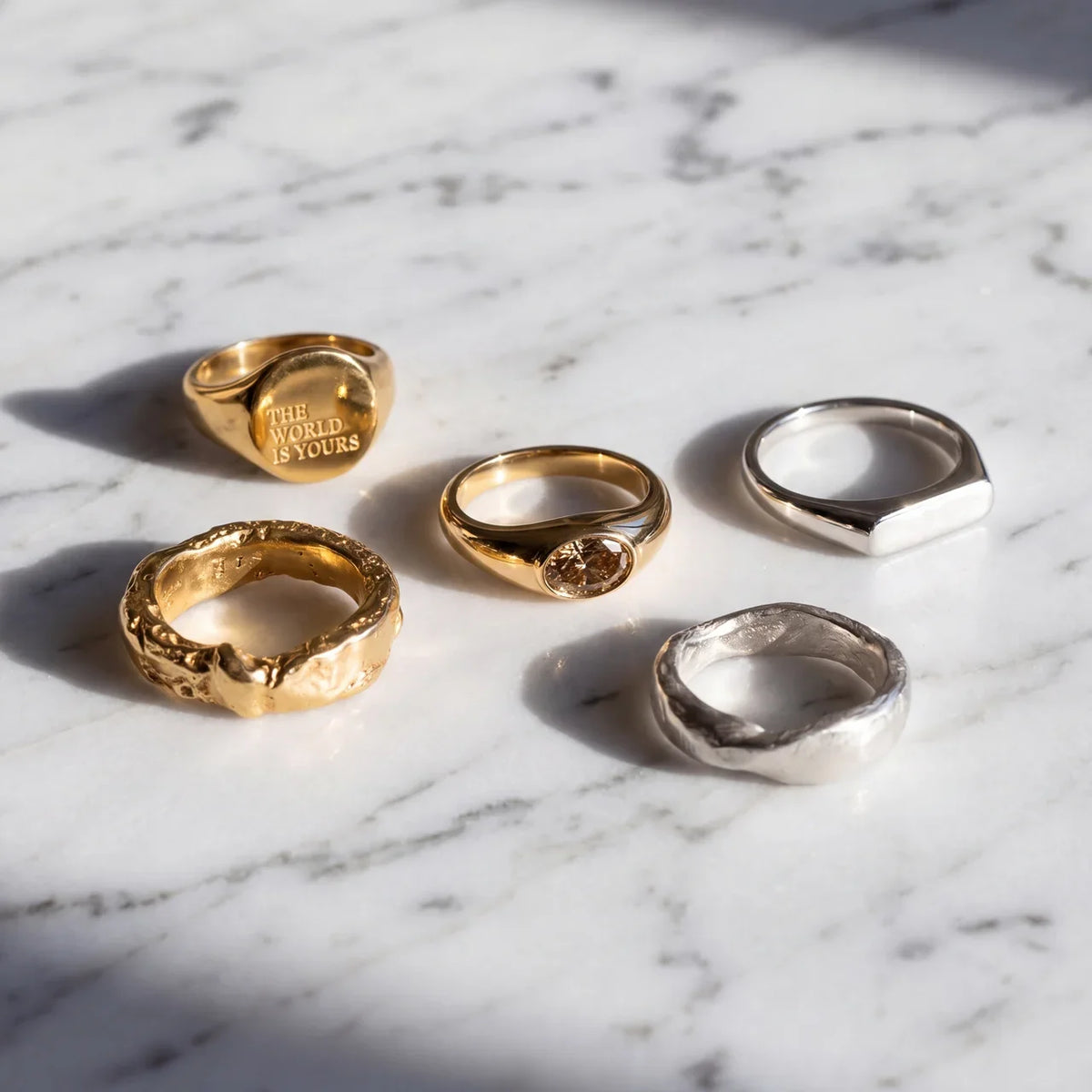
You can see the current men's signet rings line-up for reference as you read.
What is a signet ring?

A signet ring is a ring with a flat or slightly raised top face, traditionally engraved with a personal mark (family crest, initials, monogram, symbol). The “signet” name comes from the use of the ring to “sign” documents by pressing the engraved face into hot wax.
The defining features: - A flat or slightly domed top face (the “bezel”) - A rounded shank (band that goes around the finger) - Often engraved on the face
The face can be oval, round, square, or rectangular. The engraving can be reversed (intaglio, sinks into the metal) for sealing wax use, or surface (raised or shallow incised) for decorative use.
The history of the signet ring
Ancient origins (3000 BCE): Egyptian, Babylonian, and Sumerian rulers wore signet rings to seal documents.
Roman era: signet rings became status symbols. Different ranks of Romans had different ring metals (gold, silver, iron). The signet became the equivalent of a signature in legal documents.
Medieval Europe: signet rings transitioned to personal use. Family crests were engraved, used to seal letters with wax.
Renaissance and Tudor era: signet ring engraving became an art form. Kings, nobility, and merchants commissioned elaborate designs.
Victorian era: signet rings became standard men’s jewellery for the upper and middle class. Inherited heirloom signets became multi-generation family items.
20th century: signet rings became less common in business but persisted in formal settings (university rings, school rings, military rings).
2010s revival: signet rings became popular again as part of the men’s accessories renaissance. The connection to heritage and personalisation drove the comeback.
Today (2026): signet rings are one of the strongest categories in men’s jewellery, with brands offering everything from £30 PVD-plated daily wear pieces to £5000+ solid gold heirloom pieces.
Ancient origins (3000 BCE): Egyptian, Babylonian, and Sumerian rulers wore signet rings to seal documents.
Pinky vs index vs ring finger

The most important choice in signet ring style is which finger you wear it on. Each carries different cultural meaning.
Pinky finger (left or right)
Traditional position for signet rings. In English aristocratic tradition, signet rings were worn on the pinky of the non-dominant hand (left pinky for right-handed people). This is still the most common position.
Meaning: heritage, tradition, personal style. Wearing a signet on the pinky reads as “I know what this ring is” rather than “I’m just wearing a ring”.
Best for: classic / heritage / English style. Suits, smart casual, business formal.
Index finger
Modern, more confident position. Wearing a signet on the index finger draws attention to it (the index is the most visible finger in normal gesture).
Meaning: modern, confident, intentional style. Reads as “this is a style choice” rather than “this is tradition”.
Best for: modern menswear, fashion-forward styles, statement pieces.
Ring finger (left or right)
Most common in non-Western cultures. In some European traditions (French, Italian), signet rings on the right ring finger are common and don’t conflict with wedding band conventions.
Meaning: depends heavily on cultural context. In UK, wearing a signet on the left ring finger can be confused with engagement / wedding band. On the right ring finger, less confusion.
Middle finger
Rare but trending. Some modern signets are worn on the middle finger as a clear style choice (not traditional).
Meaning: clear style intentionality.
Recommendation
For UK men in 2026: - Most versatile: left pinky finger (traditional, accepted in all settings) - Modern statement: right index finger - Avoid: left ring finger (engagement / wedding confusion)
Monrich signet rings come in sizes M to Z+2, suitable for any finger choice.
Sizing for men's signet rings
Pinky finger sizing
The pinky is the smallest finger. Standard pinky sizes for men: - 5‘7”-5‘10”: UK sizes M-O for left pinky - 5‘10”-6‘2”: UK sizes N-Q for left pinky - 6‘2”+: UK sizes P-S+ for left pinky
Important: the right pinky is usually 0.5 size larger than the left pinky for right-handed men (because the dominant hand muscles are larger).
Index finger sizing
The index is significantly larger than the pinky. Standard index sizes: - 5‘7”-5‘10”: UK sizes Q-S - 5‘10”-6‘2”: UK sizes S-V - 6‘2”+: UK sizes V-Z
Ring finger sizing
- 5‘7”-5‘10”: UK sizes Q-T
- 5‘10”-6‘2”: UK sizes T-W
- 6‘2”+: UK sizes W-Z+2
Method to measure
- Wrap a strip of paper around the finger at the position where the ring will sit
- Mark where the paper overlaps
- Measure the length in mm
- Convert: UK size H = 47.8mm circumference, each size up = 1.27mm
Most jewellers offer free ring sizers (a strip with multiple sized holes). Monrich offers a free size guide on request.
The face shape is the most distinctive visual element of a signet ring.
Ring finger sizing
- 5‘7
Face shapes (oval, square, round)

The face shape is the most distinctive visual element of a signet ring.
Oval (the classic)
Most traditional. Used for crests, initials, intaglio engraving. Works in any setting.
Square / rectangular
Modern, slightly more contemporary. Works well with bolder engraving or no engraving.
Round / circular
Often used for monograms and circular symbols. Less common but classic.
Cushion (rounded square)
A modern variation, popular in 2020s revival pieces.
Free-form / sculptural
Modern designers (Vitaly, some Hatton Labs pieces) make non-traditional signet shapes. These are statement pieces.
For a first signet ring: oval or square are the most versatile.
Engraving options
Initials (most common)
1-3 letter initials, in serif or sans-serif font. Traditional and timeless. Works on any face shape.
Family crest / coat of arms
For those with documented family heraldry. Specialist engravers (College of Arms in UK) can confirm and execute. Cost: £200-1000+ for hand-engraving.
Monogram
Multiple intertwined letters (typically 2-3). Often custom-designed by the engraver. Cost: £100-500 for hand-engraving.
Symbol
A single symbol that means something to the wearer (star, anchor, snake, religious symbol). Less traditional but increasingly popular.
Date
Anniversary, birthday, milestone date. Common as “discreet” engraving on the inside of the ring band.
Coordinates
GPS coordinates of a meaningful place (where you proposed, where you grew up, etc.). Modern trend.
Quote / phrase
Short phrase inside the band. “Always”, “Family”, “Memento mori”, etc.
No engraving
A polished face with no engraving is increasingly popular. Reads as modern, minimal, intentional.
Engraving process: - Hand engraving: done by master engraver, deepest and most lasting marks. Cost £150-1000+. - Laser engraving: done by machine, very precise, lower cost. Cost £20-80. - Pantograph engraving: between the two, mid-cost, mid-quality.
For everyday signet rings: laser engraving is typically used and is sharp and lasting. For heirloom investment pieces: hand engraving by a master engraver is the tradition.
For everyday signet rings: laser engraving is typically used and is sharp and lasting. For heirloom investment pieces: hand engraving by a master engraver is the tradition.
Materials and budget
For first signet ring: PVD-plated 316L is the best value. Monrich signets start at £45 with declared PVD and free engraving.
For investment piece: solid 14K-18K gold is the heritage standard.
| Material | Price range | Lifespan | Best for |
|---|---|---|---|
| PVD-plated 316L stainless | £30-100 | 12-36 months plating | Daily wear, first signet |
| Electroplated stainless | £25-90 | 3-6 months plating | Short-term wear, occasional pieces |
| 925 sterling silver | £75-250 | Indefinite (patinas) | Investment piece, sterling preference |
| Gold vermeil (sterling + thick plating) | £150-400 | 2-5 years plating | Premium daily wear |
| Solid 9K-14K gold | £400-1500 | Indefinite | Heirloom, investment |
| Solid 18K gold | £1000-4000+ | Indefinite | Premium heirloom |
Best signet ring brands UK 2026
Monrich
PVD-plated 316L, declared 1-2µm. Permanent BOGO. Free laser engraving. Entry £45. Browse Monrich signets.
Hatton Labs
Sterling silver and solid gold signets. London craft. Entry £150 sterling. Premium quality.
Le Gramme
Solid silver and gold signets. Vicenza craft. Entry £350 silver. Investment tier.
Craftd London
Electroplated 316L. Entry £45. 60-day returns. Faster plating wear than PVD brands.
Cernucci
Electroplated 316L with hip-hop / iced-out variations. Entry £40. Streetwear positioning.
The signet alone on the chosen finger reads as classic and intentional.
How to wear a signet ring
Solo (one ring)
The signet alone on the chosen finger reads as classic and intentional. Best with smart-casual or formal outfits.
Stacked
Multiple rings on different fingers can include the signet. Common stacks: - Signet (pinky) + wedding band (ring): most common men’s combination - Signet (pinky) + minimal band (index): layered modern - Signet (index) + signet (pinky): bold, fashion-forward
With other jewellery
Signet rings pair well with Cuban chains, dog tags, ID bracelets. Avoid statement maximalism (signet + iced-out + multiple chains can over-cluster).
Caring for a signet ring
PVD-plated signets
- Wear freely. Daily, gym, shower, all OK
- Wipe occasionally with soft cloth
- Avoid abrasives
- Engraving doesn’t need special care
Sterling silver signets
- Polish patina with silver cloth every few months
- Engraving may darken slightly with patina (creates depth contrast, often desired)
- Avoid pool chlorine prolonged exposure
Solid gold signets
- Essentially zero maintenance
- Hand-engraved faces may want jeweller refresh every 10-20 years for crisp edges
If you were a Roman official, an English merchant in the 1500s, or a French noble before the Revolution, your ring pressed into hot wax was your signature.
Frequently asked questions
Which finger should a man wear a signet ring on?
Most common in UK: left pinky (traditional, accepted in all settings). Modern statement: right index finger. Avoid: left ring finger (wedding / engagement confusion).
Are signet rings out of style in 2026?
No. Signet rings have been gaining popularity since 2015 and remain one of the strongest categories in men’s jewellery in 2026.
Can you wear a signet ring with a wedding ring?
Yes. Common combinations include signet on left pinky + wedding band on left ring finger, or signet on right index + wedding band on left ring finger. Avoid signet on left ring finger (conflicts with wedding band).
How much does signet ring engraving cost?
Laser engraving (initials, simple designs): £20-50. Pantograph engraving (mid-quality): £40-100. Hand engraving (master engraver, heirloom-grade): £150-1000+. Most accessible brands include free laser engraving.
Can a signet ring be resized?
Sterling silver and solid gold signets can be resized by a jeweller within 1-2 sizes. Stainless steel signets are harder to resize (limited flexibility) but possible by a specialist. Tungsten cannot be resized.
What is the difference between a signet ring and a class ring?
A class ring is a specific subtype of signet ring designed for school / university affiliation, typically with school name and year. A signet ring is the broader category that includes personal initials, family crests, and symbol designs.
Built after wearing the others.
Different by design.
PVD-plated 316L. 1-2 micron thickness declared. 12-month tarnish guarantee in writing. Permanent buy one get one free across the full catalogue.
Browse Monrich → UK shipping 2-4 days / 30-day returns / no customs


